
Introduction
DENTAL MATCH DRAMA: WHY THE LATEST ELVIS THEORY SAYS MORE ABOUT US THAN THE TRUTH IT CLAIMS TO REVEAL
For nearly half a century, the story of Elvis Presley has refused to settle into silence.
It lingers.
In late-night conversations.
In quiet living rooms where old records still spin.
In the enduring question that has followed his name since 1977: What if the story didn't end the way we were told?
Now, in an age where a single video can travel across the world in hours, that question has found new life—this time through something as unlikely, and as unsettling, as a dental report.
Seventeen hours.
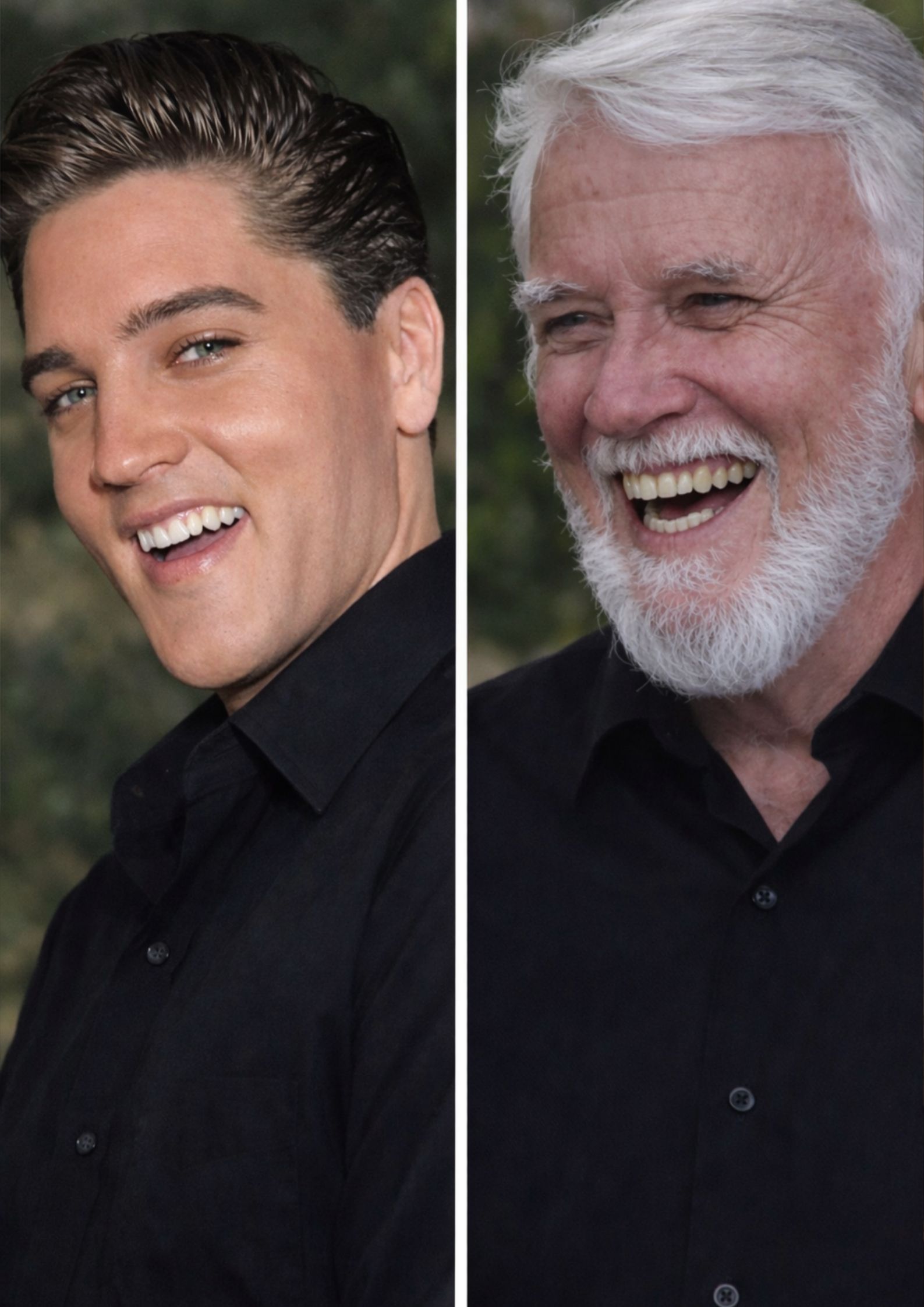
That's all it took for a niche YouTube clip and a so-called forensic analysis to reignite one of the most persistent myths in American music history: the claim that Elvis Presley is still alive—and living quietly as Arkansas pastor Bob Joyce.
At the center of the storm is a report attributed to forensic odontologist Dr. Patricia Chun, who is said to have compared dental records allegedly belonging to Elvis with visual data taken from Pastor Joyce. The conclusion, according to the video, is startling—seventeen points of similarity between the two sets of teeth, a number the narrator calls "statistically impossible to ignore."

To those already inclined to believe, it sounds like proof.
To others, it raises more questions than answers.
The most striking claim involves a chipped front tooth—something Elvis was known to have had after a stage accident in the 1950s. The video insists that Pastor Joyce has the same imperfection, in the same position, with the same angle of fracture. Alongside this, it highlights subtle details: rotated teeth, small gaps, wear patterns, even the suggestion of a missing molar that aligns with Elvis's reported dental history.
Individually, these details might seem curious.
Together, the video suggests, they form a pattern too precise to dismiss.
But this is where fascination meets uncertainty.
None of the evidence presented has been verified by independent authorities. There has been no confirmation from the Presley estate. No official statement from any recognized forensic institution. And perhaps most importantly, no DNA testing—still the gold standard for identification in cases like this.
What exists is a narrative.
A compelling one, certainly.
But still a narrative.
And in the middle of it all stands a man who has repeatedly and firmly denied any connection to the legend: Pastor Bob Joyce himself. By all public accounts, he is simply what he claims to be—a minister leading a small congregation, not a global icon in hiding.
Yet the story persists.
Why?
Because for many people—especially those who grew up with Elvis not just as a performer, but as a presence—the idea of his survival is not merely about fact. It is about feeling.
Elvis Presley was never just a singer.
He was a moment in American life.
A turning point in culture.
A voice that arrived at a time when the country itself was changing, and somehow captured both the excitement and the uncertainty of that transformation. For those who lived through it, his music is not distant history. It is memory. Personal, vivid, and deeply rooted.
So when the possibility arises—even faintly—that he might still exist somewhere beyond the official story, it touches something emotional.
Something hopeful.
The idea that he could have escaped the pressures of fame, stepped away from the "golden cage," and found peace in a quieter life resonates in a way that pure logic cannot easily dismiss. It speaks to a universal longing—not just for Elvis, but for all of us—that life might offer a second chance at simplicity.
But belief, no matter how sincere, does not replace evidence.
Skeptics point out the obvious: for this theory to be true, Elvis's death in 1977 would have had to be staged on a scale involving doctors, family members, and law enforcement. Decades of documentation, eyewitness accounts, and public record would all have to be either mistaken or deliberately concealed.
That is not a small claim.
It is an extraordinary one.
And extraordinary claims require extraordinary proof—something this latest wave of speculation does not yet provide.
There is also an ethical dimension that cannot be ignored. Turning a private individual into the center of a global conspiracy carries consequences. Pastor Joyce's life, his church, his community—all have been drawn into a spotlight he did not ask for. In a culture that often blurs the line between curiosity and intrusion, it raises an uncomfortable question: how far should fascination be allowed to go?
Still, the story continues to spread.
Because at its core, this is not just about teeth, X-rays, or forensic overlays.
It is about legacy.
It is about the way certain figures never fully leave us, no matter how many years pass. Elvis Presley belongs to a generation that still hears his voice not as nostalgia, but as something present. Something alive in memory, in feeling, in identity.
And perhaps that is the real reason these theories endure.
Not because they are proven.
But because they are powerful.
In the end, the truth remains where it has always been—just out of reach. Elvis Presley rests, officially, at Graceland. Pastor Bob Joyce continues his life in Arkansas, far from the stages that once defined the King of Rock and Roll.
Whether those two stories intersect in any meaningful way is, for now, unknown.
But the deeper question may not be whether Elvis is still alive.
It may be why, after all these years, so many people still wish he were.
Video
https://youtu.be/xNw9j_oNa6I?si=gmqg7F6N7jKDwT2z